
|
The Simons
|
|
|
The Simons
|
#include <CollectionID.h>
Inheritance diagram for CollectionID:
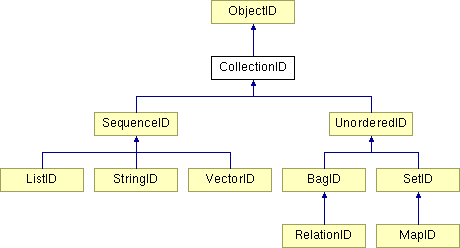
CollectionID is a strongly typed, reference counting pointer that refers to a Collection. CollectionID variables may be initialised to Collection* objects and all subtypes. CollectionID variables may alias objects held by other CollectionID variables, or any subtype. When a CollectionID acquires an object, it increments the object's reference count. When a CollectionID releases an object, it decrements the object's reference count. If the reference count reaches zero, the object is automatically deleted.
Public Member Functions | |
| CollectionID () | |
| Declare a CollectionID. | |
| ~CollectionID () | |
| Release a CollectionID. | |
| CollectionID (const Null *) | |
| Initialise a CollectionID explicitly to null. | |
| CollectionID (const Collection *) | |
| Initialise a CollectionID to refer to a Collection. | |
| CollectionID (const CollectionID &) | |
| Initialise a CollectionID to alias another CollectionID. | |
| CollectionID & | operator= (const Collection *) |
| Reassign this CollectionID to refer to a Collection. | |
| CollectionID & | operator= (const CollectionID &) |
| Reassign this CollectionID to alias another CollectionID. | |
| Collection * | operator-> () const |
| Invoke a method on this CollectionID. | |
|
|
Declare a CollectionID.
|
|
|
Release a CollectionID.
|
|
|
Initialise a CollectionID explicitly to null.
|
|
|
Initialise a CollectionID to refer to a Collection.
|
|
|
Initialise a CollectionID to alias another CollectionID.
|
|
|
Invoke a method on this CollectionID.
Reimplemented from ObjectID. Reimplemented in BagID, ListID, MapID, RelationID, SequenceID, SetID, StringID, UnorderedID, and VectorID. |
|
|
Reassign this CollectionID to alias another CollectionID.
|
|
|
Reassign this CollectionID to refer to a Collection.
|
 1.3
1.3